· 7 min read
What to include in a media kit, and how to make yours
What brands look for in an influencer media kit, which stats to include, how to show your audience and how to land your first brand collaboration.
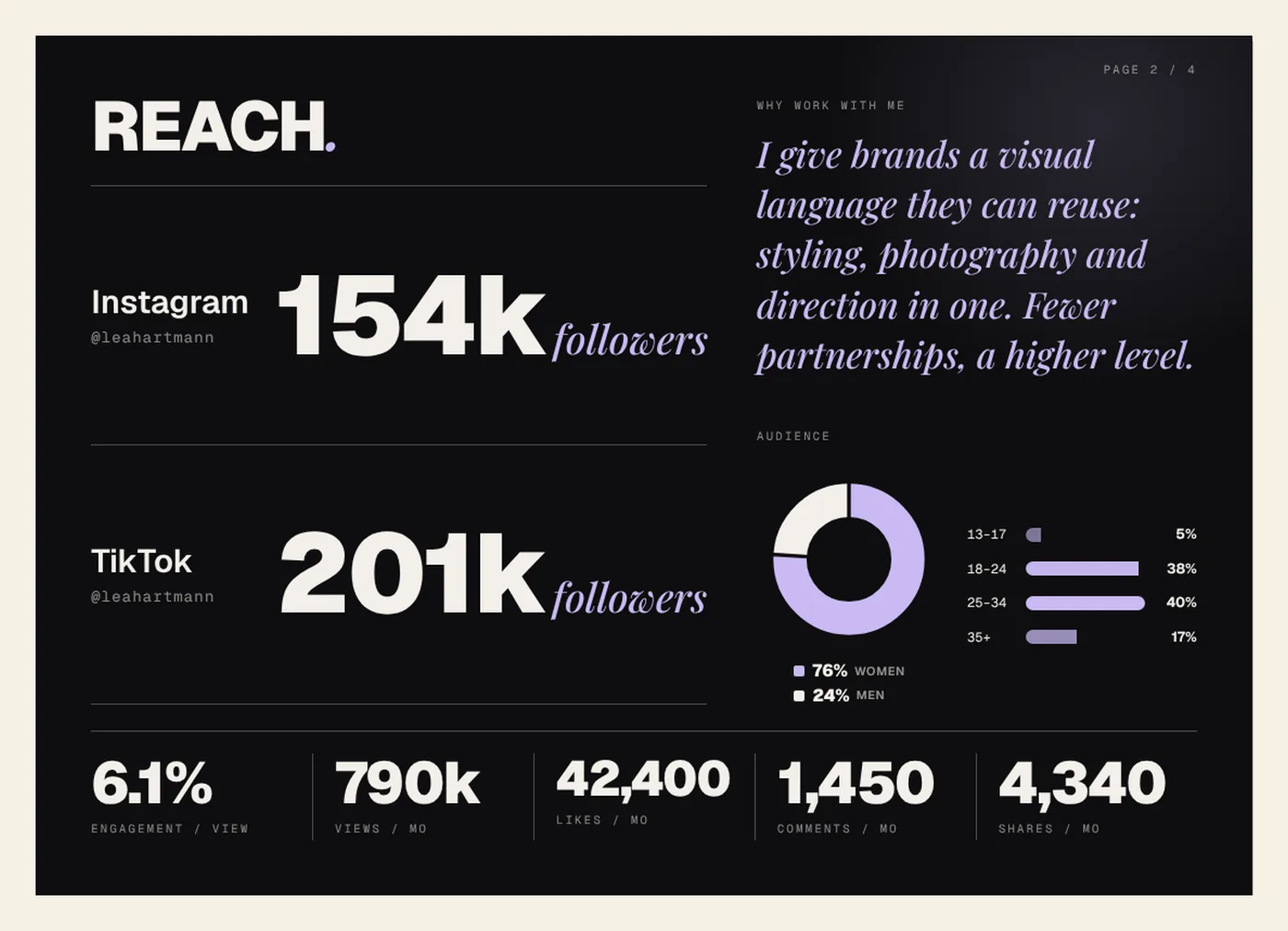
Short answer: an influencer media kit should include a short introduction (who you are and what you make content about), your channels with follower counts, your stats from the last month (views, interactions and engagement rate), your audience data (gender and age), the services you offer with rates, examples of past collaborations or your own content, and your contact details. All laid out so a brand can decide in two minutes whether you are a fit.
The rest of this guide goes through each part: what to put in, why it matters and how to present it. We wrote it from the brand side. Mediakitster is made by the team behind Unwrappa, a platform where brands post campaigns and creators apply. In that team we have reviewed thousands of creator profiles and work with brands on their campaigns, so we see up close how creators present themselves and what a brand needs to know before it picks someone. Around 850 creators are registered on Unwrappa, they have sent around 800 applications to brand campaigns, and around 100 collaborations have been closed (figures from November 2026).
What is a media kit, and how do brands use it?
A media kit is a short document, usually a PDF or a link, that presents a creator as a potential partner. It is what a brand or agency asks for before a collaboration, and what you attach when you approach a brand yourself.
The person who receives it rarely decides alone. Usually someone in marketing has a campaign to fill, compares several creators and then has to justify the choice to other people. Your media kit gets passed around when you are not there to explain it, so it has to explain itself.
What do brands look for in a media kit?
Someone evaluating a creator is really trying to answer five questions. A good media kit answers them before anyone has to ask:
- Is this audience our customer? Age, gender and the topics of your content.
- Are the numbers believable? Specific, recent and from a single source.
- What exactly can we book? Clear formats and prices.
- Is this person easy to work with? A tidy document, examples of past work and a clear contact.
- How do we reach them? A visible email address, not one hidden on the last page.
If one of those answers is missing, the reader has to email you to find it, or moves on to the next creator.
What should I include in my media kit?
- Introduction. Your name, your niche, your city and two or three sentences on what you do and for whom. A photo of you.
- Channels and followers. Instagram, TikTok, YouTube and the rest, with your handle and follower count on each.
- Stats. Views, likes, comments and shares from the last month, and your engagement rate.
- Audience. A split by gender and by age group.
- Services. The formats a brand can book: sponsored post, reel, UGC, brand ambassador and so on.
- Rates. The price of each format, in your currency, and what it includes.
- Proof. Brands you have worked with, what they said about you and examples of your content.
- Contact. Email, phone if you like, your country and the languages you create in.
Put the numbers near the top and the contact details where nobody can miss them. Rates hidden at the end only make the reader's job harder.
Which statistics should I include?
The ones that show your real reach over a recent period, usually the last month:
- Followers per channel. They give context, but they are not enough on their own.
- Views per month, or average views per video. They show how many people you actually reach.
- Likes, comments and shares per month. They show whether people react to what you post.
- Engagement rate. It sums all of that up in one percentage (how to calculate it below).
Take them from the app's own analytics (Insights on Instagram, Analytics on TikTok), not from memory. And always take every number from the same channel: TikTok likes divided by Instagram followers give a percentage that means nothing, and an attentive brand will notice.
How to calculate your engagement rate
For video, the most useful calculation today is per view:
Engagement rate = (likes + comments + shares) ÷ average views per video × 100
For example, if your videos average 30,000 views, 1,500 likes, 120 comments and 60 shares, your engagement rate is 1,680 ÷ 30,000 × 100 = 5.6%. Without views, it is calculated on the followers of your main channel, but on TikTok that can give odd numbers, because a video often reaches far more people than your followers.
How do I present my audience demographics?
Brands pick a creator for their audience, so this part carries a lot of weight. A few rules:
- Use the app's data, from the same channel and period as your other numbers.
- Show the gender split in percentages that add up to 100.
- Group ages into ranges (13-17, 18-24, 25-34, 35+) rather than giving an average.
- Connect the data to your content in your introduction: "easy recipes for people who are new to cooking" next to "70% aged 18-34" says more than the number alone.
Don't round in your favour, and don't leave out an age group you don't like. Brands often ask for screenshots of your analytics, and what is in the kit has to match.
How do I make a media kit as a small influencer?
The same way as with a big account, and with even more reason. With a small account, a media kit is what sets you apart from creators who only send a link to their profile. Lean on what you have:
- A clear niche. A small but well-defined audience can fit a brand better than a large, scattered one.
- Your engagement rate. If people comment and share, show it.
- Content examples. Even without past collaborations, you can show how you would present a product.
- Formats that don't depend on reach, such as UGC: content the brand publishes on its own channels.
- Realistic prices. A "from" price is a good starting point for a negotiation.
What information do brands need to book me?
Beyond the numbers, someone who wants to book you needs to know what they are buying. For each format, say what it includes (for example "1 reel of 30 to 45 seconds and 3 stories"), what it costs and, where it matters, how long the brand may use the content. Add the languages you create in and the country you work from. The fewer questions a brand has to ask, the sooner it replies.
How do I get my first brand collaboration?
- Have your media kit ready before you contact anyone, as a PDF and as a link.
- Pick brands that already fit your content and your audience, not necessarily the biggest ones.
- Keep it short: who you are, one concrete idea for that brand and the kit attached. Three sentences are enough.
- Look for open campaigns. On platforms like Unwrappa, brands post campaigns and creators apply directly, from gifted products to paid collaborations.
- Update your numbers every few months, and always before you pitch.
Nobody can guarantee you a collaboration, but a clear media kit makes "yes" a lot easier to say.
Should my media kit be in English?
If you work with international brands, or with agencies that compare creators from several countries, English is the safe choice: everyone in the chain can read it and forward it. If most of your collaborations are with brands in one country, a kit in that country's language is read faster and forwarded without translation. Many creators keep both.
How to create your media kit with Mediakitster
Knowing what to include is one thing; deciding the order, the structure and the design is another, and that is where whole evenings go. Mediakitster does that part for you: you don't lay anything out, you answer questions.
- Answer eight short steps: you, contact, channels, stats, audience, services, rates and proof. Each step explains what to enter and why it matters to a brand, and your engagement rate is calculated from your numbers.
- Pick the kit language. If you start here, English is already selected. The same answers can also print in Swedish, Spanish, German, French, Portuguese, Italian or Polish.
- Choose a style. Your answers arrange themselves into a professionally structured kit; the style only changes the look, and you can switch without retyping anything.
- Check the full preview for free, with a watermark.
- Pay once and download the high-resolution PDF, which you also get by email, along with a link to share.